
Muskegon Heights Warrant Checks
The city posts no warrant list and runs no public name search. A Muskegon Heights warrant check means calling each office that holds part of the file, one at a time.
- Call the Muskegon Heights Police Department at 231-733-8900 and ask the desk to identify the report or citation behind your paperwork.
- Ask for the citation number or case number, since a court clerk works from that number rather than from a name.
- Search the 60th District Court caseload through MiCOURT D60, which the state labels an informational aid rather than the official record.
- Call the 60th District Court at 231-724-6294 and ask whether the file shows an active warrant, a bond, or a hearing date.
- Send a written records request to the city or the county when you need an existing document instead of a status answer.
Note: A name missing from the county inmate list proves nothing, because a warrant can be active while a person is not in custody.
Muskegon Heights Police Records or Court Warrants?
The two questions sound alike, but they are different. One asks what an officer wrote down. The other asks what a judge ordered. The Muskegon Heights police desk can confirm that a report or citation exists and give you its number, yet it cannot tell you a warrant was recalled, since the court controls that status. The 60th District Court, in turn, can confirm both the case and the warrant but will not release a police report. Ask each office only for the half it owns.
Policing and Courts in Muskegon Heights
Muskegon Heights counted 9,917 residents in the 2020 Census. Its police department is full-service, writing reports and citations under both city ordinance and state law.
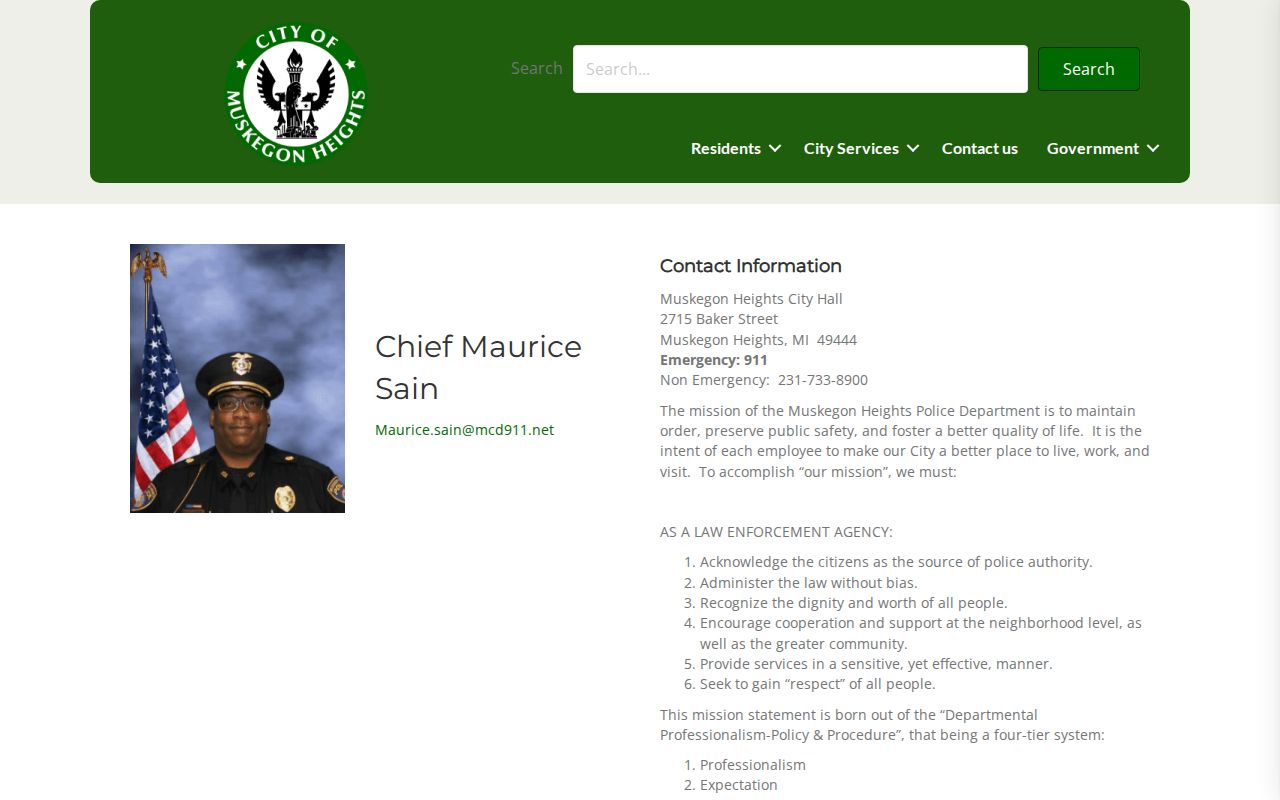
The department publishes its page at muskegonheights.us/police. It covers the agency side of a case. The county court handles the legal side.
Muskegon Heights Police Department
City Hall, 2715 Baker Street. Writes city reports, citations, and ordinance process.
231-733-8900
60th District Court
990 Terrace Street, Suite 100. Hears adult traffic, misdemeanor, and felony-preliminary cases.
231-724-6294
The county's official court sources list no separate Muskegon Heights municipal court. Adult cases follow the countywide court route instead.
Which Muskegon Heights City Hall Address?
Official Muskegon Heights pages give two city addresses, and they are not the same building reference. The police page places the department at 2715 Baker Street. The city contact page, meanwhile, lists the city clerk at 231-733-8820 with a City Hall address of 2724 Peck Street. Call before you travel. Ask whoever answers whether your question belongs to the police records desk or to the clerk, and confirm which counter handles the document you want. That call settles a related point too. A police record and a clerk record are separate city files, so neither office can hand you the other's paperwork.
Warrants in Muskegon Heights: The Main Types
A case that begins with a Muskegon Heights officer can end in more than one kind of court process. What went wrong after the charge or ticket decides which one you face.
| Type | How It Arises | Who Issues It |
|---|---|---|
| Arrest warrant | A city report leads to a complaint and a probable-cause finding | A judge or authorized district magistrate |
| Bench warrant | A missed court date or a violated court order | The judge in the open case |
| Traffic or ordinance warrant | An unanswered city citation | The court named on the citation |
| Family or support warrant | A missed support or family hearing | Family Court or the Friend of the Court |
Michigan court materials use one label for a missed appearance. Bench warrant is the phrase to repeat when you call about a Muskegon Heights case.
Muskegon Heights Clerk FOIA Requests
The county's records page routes Muskegon Heights incidents to the city's own FOIA policy rather than the sheriff's form. That routing matters, since a report written by a city officer stays a city record no matter where the case was filed later. The city contact page names the clerk's office as the place to start for city documents. Put your request in writing, describe the record, give a date range or citation number, and say whether you want to inspect the file or receive a copy. One limit applies. A records office produces documents that already exist. It does not build a new list or rule on a warrant's legal status.
Muskegon Heights Warrant Records: What They Show
A court file for a Muskegon Heights case carries the same parts as any adult case in this county. These are the pieces a clerk works from when you call.
| Case Number | The court file number, and the reference every clerk asks for first. |
|---|---|
| Charge or Citation | The offense as filed, whether it is a state charge or a city ordinance. |
| Issuing Court | The court that signed the process, usually the 60th District Court for adult matters. |
| Originating Agency | The Muskegon Heights police unit that wrote the report or citation. |
| Bond or Fine | Any amount the court set, which is separate from a city copy fee. |
| Status | Open, defaulted, recalled, or resolved, as the court reads it. |
Muskegon Heights paperwork follows state forms. A felony warrant runs on form MC 200w, while a misdemeanor warrant uses DC 225w.
Silent Observer and Muskegon Heights Warrants
Muskegon Heights takes part in Silent Observer. The city publishes the program's contact routes on its own page: text MKGTIP to 274637, call 231-72-CRIME, send a web tip, or use the TipSubmit app.
A Silent Observer message is a crime tip. It is not a warrant check, it cannot confirm your court status, and it will not clear a warrant.
The city tip page and the county program site describe a channel for reporting information about an offense. Use the court for your own case. Save the tip line for what you know about someone else's in Muskegon Heights.
Muskegon Heights Citation to Court Warrant
The trip from a city ticket to a court warrant runs through several stages, and each stage hands the file to a different office. An officer writes a report or hands over a citation. A prosecutor presents a complaint. A judge or magistrate reviews the facts and signs a warrant or a summons. An officer then serves the process, and the person appears for arraignment and a bond decision. Once the Muskegon Heights court has the case, the city is out of the loop on status.
Note: The 60th District Court asks anyone with an active warrant to call before appearing to ask about remote arraignment options.
Muskegon Heights Warrants and Muskegon County
A Muskegon Heights case does not stay inside the city line once it reaches the courthouse. Adult charges run through the county court system. A felony can move to the circuit court after the preliminary stage.
Warrant flow: Muskegon Heights police report › 60th District Court warrant › 14th Circuit Court after bindover
Keep that flow in mind when you call. A misdemeanor question stays with the district court. A felony question may also need the sixth-floor records counter. The Muskegon County warrant records page lays out the countywide court and sheriff structure for Muskegon Heights cases.
Muskegon Heights Warrant Phone Questions
A few notes before you dial will get you farther with the Muskegon Heights court. Put the citation or case number at the top of the page. Then write out the questions you need answered. Which court holds the case, and under what number? Does the file show an active warrant? Ask whether you can appear voluntarily or by remote connection instead of in person, and what bond type and amount the court has set. It also helps to ask what document proves a warrant has been cleared. Staff at the window handle routing and status questions all day, but they cannot give legal advice. A question about recall grounds or defense strategy belongs with a lawyer, not the clerk.
Accessing Muskegon Heights Warrant Records
Michigan's open-records law covers what a public body holds, and the courts layer their own access rules on top. Sealed and juvenile files stay closed to a Muskegon Heights records request, no matter who asks.
Key Rules:
Michigan Freedom of Information Act, MCL 15.231 gives the public a right to inspect and copy records held by public bodies, with listed exemptions.
MCL 15.235 sets the response timeline, the possible extension, and the fee rules a requester should expect.
MCL 15.243 allows law enforcement records to be withheld or redacted where release would interfere with an investigation, invade privacy, or expose a confidential source.
A denial settles nothing about the warrant itself. The paper may sit with a different office, or an exemption may apply, so the issuing Muskegon Heights court remains the place to confirm the case.